I’ve been thinking lately about what kinds of emergent narrative really hit with delight and surprise and why they do so.
One day while playing Crusader Kings III, my paranoid ruler (I hate playing paranoid characters, but it happens sometimes) had a child. Lo and behold, this child was not a successful specimen of my eugenics project but rather a scale-covered abomination. What could have gone wrong? Why was I cursed with this creature when I wanted a healthy, strong, beautiful firstborn son?
The game didn’t register what a remarkable and truly unlikely thing had happened. A few children later, it happened again. Well, this is just beyond all measure of probability, my paranoid ruler thought (through my brain). The game still didn’t notice.
This is why I made my Lizard Among Us mod. Something unexpected occurred – a lizard emerged. The emergence that mattered for me wasn’t the scaly children themselves, but the opportunity for story that they presented.
We characterize emergent narratives as the stories that arise unplanned during the course of play. What typically happens is something occurs and the player creates a rationalization for why it occurred. The emergent event is the end of the story. In the scaly child case, perhaps my ruler’s wife had a scaly lover on the side. Perhaps my generations of inbreeding had invited a curse of the gods. But those explanations were unsatisfying. I wanted my emergent scales to be the start of the story. What would my paranoid ruler do, how would he react?
I think it is this surprise that makes emergence interesting. Players have expectations of what will happen, and sometimes, the game does something you don’t expect that is, in some way, interesting. What happens next is even more so.
I had a Sim once who went on vacation to Mt. Komorebi, the Sim version of Japan. While there, she had a whirlwind romance, got pregnant, and eloped with her newfound lover. Once home, all seemed well, until it became clear that her Romeo was actually just a Sim who did nothing but play video games. Child needs care? Ah well. Romeo himself is hungry? Can no one feed him? He certainly believes himself incapable of doing so.
I had a good chuckle at this. Of all the random Sims in Sim-Japan, I had to find the one who refused to contribute anything to the household. He had no trait that led me to expect this. He just loved video games that much.

This presented an opportunity. I didn’t really like my Sim’s choices. Turns out she’d had a first husband whom she still had the hots for, and he was vastly more useful around the house. Here was a ready-made divorce reason that could kick out the deadbeat and bring back her true love.
Now I could have just done all that myself and either pretended or forced Mr. Sim-Japan to be a useless roommate. But he did it himself when I didn’t expect it, and that made it interesting. That presented an opportunity for a story. The emergence was the beginning of what would become a swift divorce.
In history games, these expectations can be higher stakes. I caught a glimpse into one of the many possible emergent events in Civ VII, the newest iteration in the storied series.
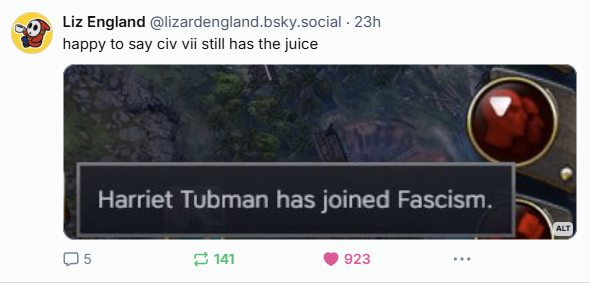
Now, I would generally expect an American leader to be the opposite of fascist. That seems less so these days, unfortunately, but even now, I do not think an abolitionist would be on their side. This event is interesting because it is unexpected.
I mentioned it to a friend who said,
“I’d believe it, she’s bloodthirsty.”
In the game, Harriet Tubman is both diplomatic and militaristic. It is this militaristic nature that likely leads her to pursue fascism as the ideology provides numerous benefits to the warmongers among us.
This means that within the game, it’s consistent and coherent that Harriet Tubman becomes a fascist. But in real life, she only led military forces in the pursuit of freedom for those who were enslaved. We think of her as an activist for justice and for human rights, not a bloodthirsty fascist. Her becoming one is unexpected and historically unbelievable.
This gap in historical likelihood and narrative coherence results in an emergent event that we find interesting. The game, however, doesn’t notice it. She’s just doing Harriet things. But it could be an opportunity for new stories. How would my democratic leader react to Harriet Tubman pursuing fascism? How would my fascist leader react to Harriet Tubman pursuing fascism? (Is Harriet Tubman Harriet Tubman at all, gasp?)

The emergent narratives I especially enjoy are the ones that provide opportunities for stories to emerge, rather than the ones that close out stories that already happened.
The difficulty is in predicting what those events will be, and then creating content to surface when they happen. Harriet becoming fascist is actually pretty predictable, considering her in-game qualities. I wonder if this was an intentional choice to allow for such occurrences. You can certainly argue for her to be militaristic – she did use armed methods to achieve her aims. It’s historically believable that she would fight for what she believes in with the means at her disposal. Creating her thus while knowing the game’s ideologies would likely lead to her becoming fascist? Bold. And what a great opportunity for storytelling.
 Ada Plays
Leave a comment