This morning, the 4th annual Digital Media & Learning Competition was announced on the theme of “Badges for Lifelong Learning”. Around 10:15am or so, Twitter started erupting in very odd comments tagged with #dmlbadges from HASTAC’s live feed.
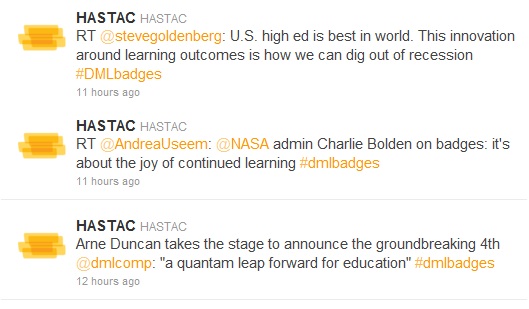
Very big claims. I reacted quite strongly, as did many of my colleagues, and we were branded “haters”. But we weren’t hating – we were critiquing. I worried throughout the day though that I had “critiqued” too strongly. Maybe I had assumptions that weren’t correct. Maybe I was too invested, had too much at stake. Maybe I was just a grad student who should have kept quiet and let the big guns sort it out.
Perhaps my language was too antagonistic, but I no longer fear that the reaction was unwarranted. Over at @digitaldigs, a lovely piece surfaced this evening entitled, “Welcome to Badge World”. It’s a stark vision of the place being created in front of us. A place where my son’s after-school activity isn’t decided by his interests, but by what gives the best badge, the one that the prep schools or the summer programs or even the colleges care about. You want to play basketball? Sorry, you aren’t good enough to win a college scholarship so instead, we’re putting you on the debate team because the debate badge has been shown to increase acceptance chances by 12.5%. A more real-world and actual example can be found in this app that partners with local golf courses to offer deals for participants. The hook? You have to gamify your game of golf and earn badges for playing a game that already has an assessment system. You can’t just play golf with your buddies and get a coupon – you have to badge-ify it. This is a whole new kind of meta-gaming.
At first, I was upset because badges are this piece of games that get detached from their home, appropriated and used for some shallow incentive. Games have so much potential for learning, a fact that was also in the public discourse yesterday when the ESA head presented to Congress on the value of games in education. I found myself wishing that the committee in charge of this program had paid more attention to or even heard that presentation first. It’s unfair to take a piece of games and expect the power of games to come along with it. But maybe this isn’t about game-based learning at all. It’s just about putting a point value on everything we do.
But Boy Scouts and the military have badges! Surely, it can’t be that bad of a system. It seems harmless, doesn’t it? Like getting a gold star on your worksheet. You see a gold star, you want a gold star, you work for a gold star. Bibbidi, bobbidi, boo – learning! But it’s not that simple. The most respected badges are those which have no guidelines, no strict rules to acquire them. They are exceptional and earned in exceptional circumstances by exceptional people. Most importantly, they’re earned not by trying to earn them at all. They are sometimes won by ignoring the rules altogether.
Let’s think about the badges we already have in education – degrees and test scores, the proofs of learning. Consider a student who cares about passing (badges are pass/fail) his history final so crams all night, promptly forgetting everything in the drunken stupor that follows the aced exam.
Or students who don’t actually care about learning how to write in college – they care about finding out what this particular teacher wants and then milking the A out of them.
Or teachers who end up teaching to the test for a one-time score instead of teaching the critical thinking and observation skills needed to succeed in the long-term. (Yes, see above.)
Or any number of examples in which learning and knowledge are no longer the goals, but rather, the perk acquired in the process of gaining some form of badge.
Systems of badges may not come from games. In fact, they may denounce any connection to games and even say they are not a form of “gamification” as happened during the announcement of #dmlbadges this morning. They cannot deny or change the fact, however, that they create a game in their appropriation of a game feature. It’s not about learning anymore; it’s about getting a badge. In such a system where there is a complex construct of rules and loopholes with one final goal, humans will attempt to find the most efficient path to that goal. Mice to cheese, if you will. It’s not about trying to enrich yourself; it’s about trying to pad your badge backpack, trying to game the badge system. What if we change those standardized tests into badges for critical thinking? Well, how is it assessed? How is critical thinking judged? Is school funding dependent on quantity of badges? What is the most efficient path to the badge? I don’t see any actual change in the system here – I see a new layer of paint. It’s an ugly mutation of what badges perhaps idealistically are – a symbol for actual expertise and experience. Ideally perhaps, there is no value in a badge – there is value in what it represents. But instead, badges are a goal in and of themselves, a commodity, a currency of the job market, of success. Life becomes defined by badges, all experience reduced to a virtual backpack.
There’s another problem with badges and it exists not only here, but in games themselves. I gave a presentation at the Canadian Game Studies Association’s annual meeting this spring on achievement systems in games, and part of the discussion focused on how achievements create a valuation system independent of the game itself. For example, there are achievements in World of Warcraft for any number of activities – killing, exploring, collecting, and drinking. But only certain kinds. You can explore every part of the map, but not all of it will count for an achievement. There is only value in the places that are listed on the badge itself – all the other corners of the world, the things you may stumble upon, the details that the designers put in have no apparent value. They have no achievement. They do not matter to anyone except you. Let’s say that you are a social guru and organize server events for your community. In other words, you’re an outstanding community member and player of the game. No achievement, no value for anyone outside of your own small part of the entire game’s community. Badges (and thus value) are defined by others. When a hole in that value code is found, one response is: Let’s just add more achievements/badges then! We’ll had an achievement for every corner, every friend, every boar!
This is frighteningly similar to the problem that the Badges for Lifelong Learning program is trying to solve but also to its intended solution. The observation is that people gain expertise in non-traditional areas which have no value because they have no accredited degree or something similar. So let’s give them badges, the program says. Let’s add that corner of the world to the list. Except that there is no system that can possibly account for the variety of expertise and of the manners in which it is gained. (The committee may say, “…yet!”) There is no system that can quantify learning to such an extent (nor perhaps should there be?). As some kinds of learning and knowledge are elevated to value by the badge system, all the others will be not just left alone as unaccredited pastimes or learning for the joy of learning, but even lowered to the point of worthless. It is here that I return to my initial problem with the system – that it is a shallow and pathetic substitute for what game-based learning can be. In a culture already time-poor, play, one of the most powerful learning tools available, is reduced to a waste of time and a worthless activity, simply because it cannot be badge-ified. And if someone succeeds in badge-ifying it? Well then it is just another badge, just another gray uniform, just another expressionless face in the long line of badge-holders.
My greatest hope for this system is that the outpouring of critical responses will encourage the competitors to think deeply about the programs they propose. I especially hope the committee funds critical research through the research competition portion of the program and I look forward to the results of what seems to be the start of a powerful and provocative discussion among educators and academics.
 Ada Plays
Leave a comment